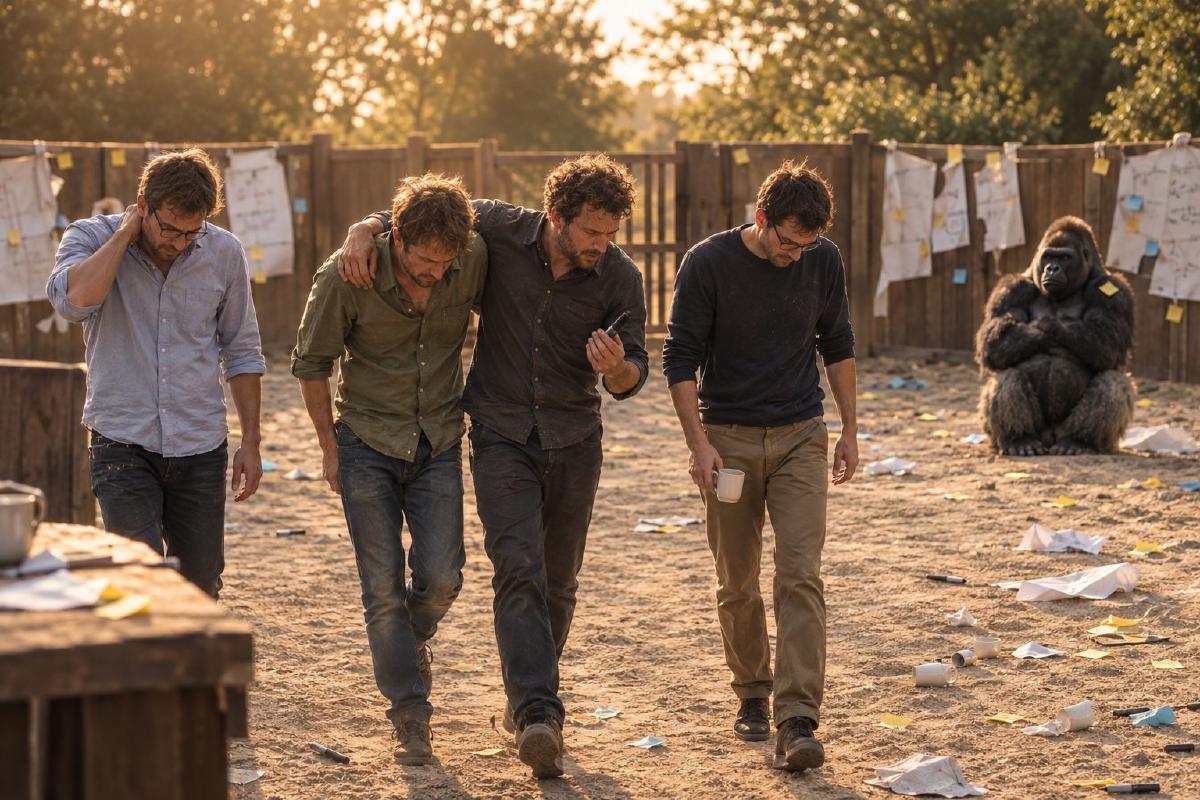

The gorilla debate never ended. Nobody won it. People just got bored and moved on to the next question.
In the first post of this series I argued that this is a problem with taking a question apart. It has no natural end. You can always split it once more. In the second I looked at the people who go first into the unknown, and ended on an uncomfortable observation: they often don’t come back out.
Both endings point to the same gap. Programmes are good at planning the programme, with milestones and go-live dates. What’s often missing is a definition of done for the single topic inside it. When is this question answered well enough? When is this person’s part finished? That gap applies to thinking, and it applies to people.
Stopping the Thinking#
Most teams don’t overthink because they’re slow. They overthink because nobody said how much thinking the question deserves, so the analysis runs until a deadline or a steering committee stops it from outside. A few tools help me set that limit from the inside.
Ask how reversible it is. Jeff Bezos split decisions into two types in his shareholder letter for 2015. Some are one-way doors, hard or impossible to undo, and they deserve slow, careful thinking. Most are two-way doors. If you got it wrong, you walk back through, so a small group should make the call quickly.
His warning was that large organisations tend to treat every door as one-way. I recognise that. The choice of a pilot group1 ends up with the same review depth as the choice of an identity provider.
Give the concerns a slot. Gary Klein’s pre-mortem, described in Harvard Business Review in 2007, goes like this. Before you start, you assume the project has failed, and everyone writes down why. It sounds gloomy, but in practice it’s a relief. The people who see risks get a legitimate place to say so, early and all at once. That’s much cheaper than the same concerns trickling in over six months, which, as the last post argued, is what wears down the first wave.
Write down what would change your mind. When the team settles something, add one line to the record: what would have to be true for us to reopen it. The team can stop debating today without shutting the door on new facts. And when someone wants to reopen it, the first question is simple. Has that condition happened?
These tools don’t shorten the analysis on their own. They only work if the team agrees on the limit before the thinking starts.
Stopping the Involvement#
The second kind of stopping is harder, because it’s about people.
The volunteer who took the unscoped topic at kickoff is perfect for the first months. Then the topic changes. The unknowns get resolved, the design is fixed, and what’s left is execution: run books, change requests, a hundred small calls that all have to go the same way. That’s different work, and often a different person does it better.
Yet the volunteer usually stays, and rarely out of bad intent.
- The knowledge sits in their head. Decisions made during exploration are rarely written down, so the person becomes the documentation.
- The organisation sees them as the owner. Every question about the topic goes to them, which confirms it.
- They are attached to it. They built it from nothing, and handing it over feels like losing it.
The pattern isn’t new. Simon Wardley describes three profiles that work best at different stages: pioneers, settlers and town planners. Pioneers explore the unknown, settlers turn early results into something usable, town planners industrialise it. He credits the idea to an older comparison by Robert X. Cringely of commandos, infantry and police.
What most programmes lack is a plan for this. We staff by work stream, not by phase, and nobody schedules the moment the pioneer hands over to the settler. So it either never happens, or it happens badly. The pioneer burns out, gets frustrated with the slow phase, or gets replaced in a way that feels like a demotion.
Making the Handover Work#
If the handover only comes up when someone is exhausted, it will always feel like a judgement. It has to come up much earlier.
The best moment to plan the exit is when someone raises a hand. Something like: “You shape this until the solution design is decided. Then it moves to someone who runs it, and you move on to the next open topic.” At kickoff, that’s a plan, and a compliment too. In month fourteen, the same sentence sounds like you’re taking the topic away.
Tie it to a trigger rather than a date. Dates are guesses, and in programmes they move. A better signal is when the main unknowns are resolved, the design is signed off, and what’s left is execution. Hand over before that and you lose the person who knows why things were decided. Wait a year too long and you’ve kept a pioneer in a settler’s job.
And handovers aren’t free. Context gets lost every time. Whoever takes over may feel they’ve inherited someone else’s mess, and sometimes they have. Plan an overlap, insist that the decisions get written down, and accept that the first weeks will be slower. Pretending a handover costs nothing is how organisations talk themselves out of doing one.
This doesn’t mean removing every pioneer after phase one. Some want to see their topic through, and some are good at it. That’s fine. Someone should simply have asked them, and agreed it with them.
Back to the Gorilla, One Last Time#
Three posts on a question I called ridiculous at first.2 I am well aware of the irony.
But the useful part was never who wins. It was the questions underneath. How far do you take a question apart before you act? Who goes first, and what does it cost them? And when do you stop, both the thinking and the fighting?
Is there a clean answer for each of them? Nah, but each one gets a better answer when someone settles it before the fight starts. In my experience that’s what leadership is for. Leaders who see it coming and raise it early save everyone a lot of pain along the way.